November 10, 2026|Client Alerts
Silence Is Consent: Public Companies Have 30 Days to Object to Tokenized Trading of Their Stock
By Ashwin J. Ram

Insights
November 10, 2026|Client Alerts
By Ashwin J. Ram
Under a new SEC order, a venue can trade a third party’s token of your stock unless you object in writing within 30 days of its notice. As of Nov. 5, 2026, 67 issuers had objected to OKXICE TSV, a joint venture of Intercontinental Exchange and OKX. They include Apple, Microsoft, Alphabet, NVIDIA, Amazon and JPMorgan.
A company that has not decided should do so now. The Order offers no clear way to object once the window closes, and case law gives issuers little to fall back on. A separate window to challenge the Order itself in court appears to close Nov. 16.
The SEC’s Sept. 17, 2026 order (Release No. 34-106402) lets a Tokenized Securities Venue (TSV) trade tokens of listed stocks without registering as an exchange or alternative trading system. The relief runs until Sept. 17, 2031, and the SEC may modify it. A venue files no application; it posts a notice on its website at least 30 days before operating and tells the SEC.
Trades run through automated pools on a public blockchain, not an order book. Pool prices generally follow the ratio of assets in the pool, “without directly considering external pricing.”
The Order does not require any company to tokenize its stock. The concern is tokens created by others. Under OKXICE’s model, a third-party tokenizer holds real shares through a broker-dealer and issues tokens against them; the issuer need not be involved.
The right is short, runs venue by venue, and depends on a notice (an “Issuer Notice”) that may never reach anyone who can act on it. Your reply is a “Notice of Issuer Objection.”
| Point | What the Order says | What it means for you |
| Delivery | The notice goes to the physical or email address for your principal executive offices on the cover of your Exchange Act reports. | That is often a general mailbox, and nothing requires marking it for Legal. |
| Deadline | Your objection is due “on or prior to the 30th calendar day following receipt.” | “Receipt” is undefined. SIFMA has asked whether a notice caught by a spam filter starts the clock. |
| Effect | The TSV “cannot make such Tokenized NMS Stock available for trading.” | The block applies to that venue only. One letter does not bind another. |
| Publicity | The TSV must name you in its public Notice within five business days. | Objecting is public, but you would be in large company. |
| After day 30 | The Order provides no later objection. SEC staff says a TSV can trade once the period lapses without a timely objection. | SIFMA says the Order “treats an issuer’s silence as consent” and has asked the SEC to confirm a later right. |
Objection is now the norm among large issuers: OKXICE’s published count rose from 1 to 67 in 32 days.
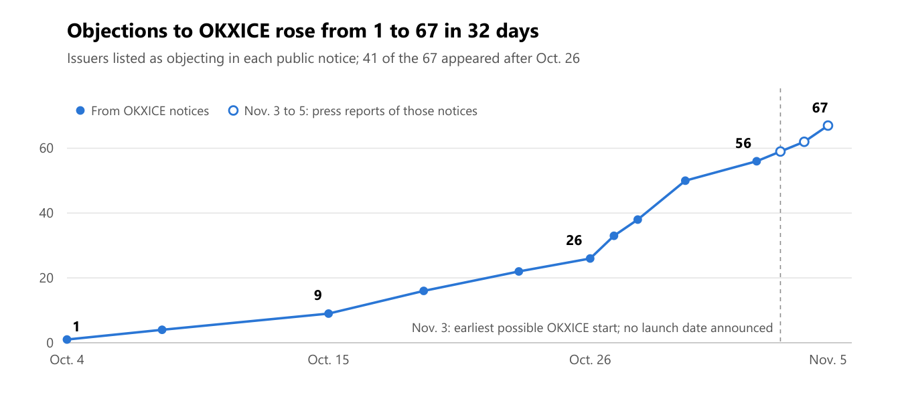
Of the 62 companies OKXICE named on Oct. 4, 56 have now objected, along with 11 companies it had not named. The six that had not objected as of Nov. 5 all have ties to the crypto industry: Strategy, Coinbase, Robinhood, Circle, Securitize and BitGo.
Absence from the list does not mean consent, and some windows may still be open. Others have likely closed: Cerebras’s objection appears in the Oct. 4 notice, which suggests some Issuer Notices went out by then, and day 30 for those came by Nov. 3.
OKXICE TSV, Perpetuals.com and TSV LLC remain the only filers on the SEC’s list, last updated Oct. 26. TSV LLC began trading on Nov. 4 with a token of Canton Strategic Holdings stock that the issuer authorized, so no objection right arose. OKXICE could have started Nov. 3 but has not announced a launch date; Perpetuals.com can start Nov. 13. More venues can file at any time.
Goldman Sachs sent Perpetuals.com what the venue calls a “preemptive” objection, and the venue agreed not to trade Goldman stock. The Order measures from a received notice, though, so another venue might not honor one.
SIFMA told the SEC on Oct. 19 that third-party tokens should trade only with an issuer’s affirmative consent. By its own account, that would require amending the Order.
For most public companies, we would object now and revisit once the market has a track record. The choice is lopsided: a company that objects can still tokenize later on its own terms, but silence has no clear undo. The objection may also be the only real veto you have: courts have refused to give issuers control over trading in their stock or options on it.
Three issues should drive the decision:
A company that wants token access for its investors may reasonably stay silent or engage with a venue. If so, make that a recorded decision, not a missed deadline.
The goal is that a notice reaches a decision-maker within a day and an objection arrives well before day 30.
Sample objection
[Company] objects under Section II.D of SEC Release No. 34-106402 to any Tokenized NMS Stock representing any class of [Company]’s stock, tokenized by any third party unaffiliated with [Company], being made available for trading on [TSV] or any affiliated venue. This letter is a Notice of Issuer Objection. [Company] reserves all rights.
An objection does not reach tokens traded offshore or outside the Order. Extend your insider trading policy to tokenized stock at any hour, bar insiders from supplying liquidity to pools holding company stock, and prepare a short statement on whether you sponsor any token.
A venue that skips notice or trades over a timely objection “would not meet the conditions” of the exemption for that stock. That may leave it in violation of Section 5 of the Exchange Act (no trading on an unregistered exchange).
Under footnote 101 of the Order, listing a third-party token represents that the venue gave Issuer Notice, so a false listing could support an antifraud theory for the SEC or token buyers.
We found no court decision on an issuer’s rights against a tokenized stock venue. The closest cases favor the venue, so plan around the objection and the SEC, not a lawsuit.
| Theory | Where it stands |
| Enforcing the Order | The Order says nothing about a private right, and an agency cannot create one. The Supreme Court repeated in June that Congress decides who may sue (FS Credit v. Saba). We found no court recognizing a private right under Section 5 (no trading on an unregistered exchange). |
| Rescission under Section 29(b) (contracts that violate the Exchange Act are void) | This remedy reaches only an unlawful contract, and an issuer has no contract with token traders (Risley, a non-precedential order; Xeriant). |
| Rule 10b-5 (securities fraud) | Damages require that you bought or sold (Blue Chip Stamps). Courts are divided on whether a non-trading issuer can seek an injunction (USANA; Cowin). |
| Property and unfair competition | The closest case is Golden Nugget (9th Cir. 1987). An exchange listed options on an issuer’s stock without consent, and the court rejected the issuer’s claims because the exchange dealt only in its shareholders’ property. The Seventh and Second Circuits have followed that reasoning. A token backed one-for-one by real shares looks at least as close to the stock as an option, though no court has said so. |
| Trademark | A seller may describe a stock accurately by name (Golden Nugget; Dow Jones v. ISE). Your best theory is implied sponsorship under Section 43(a) of the Lanham Act (false suggestion of sponsorship or approval): a claim over advertising survived dismissal in Nasdaq v. Archipelago, though the court called it weak. A venue will cite LegalForce (9th Cir. 2024), which held that a company’s sale of its own equity is not use of a mark with goods or services, though a venue’s trading service is a different target. |
The objection is the remedy that works. If a venue or tokenizer uses your logo or suggests you stand behind a token, preserve the evidence, because that is where a private claim has its best chance.
An objection blocks one venue. A company or trade group that wants to change the rule for every venue has a separate route, and it closes soon. Section 25(a) of the Exchange Act (court review of SEC orders) lets a “person aggrieved” by a final SEC order petition a federal court of appeals within 60 days after entry. For this Order, that appears to be Monday, Nov. 16, 2026. A PACER search on Nov. 3 found no petition, and we found no report of one through Nov. 6. Better Markets has told the SEC the Order is unlawful and needed notice and comment, and SIFMA has questioned its legal basis, but neither mentions a lawsuit.
| Point | Where it stands |
| Deadline | The clock runs from the Sept. 17 date on the Order, not its Sept. 22 Federal Register publication. In NYSE v. SEC (2021), the D.C. Circuit dismissed petitions filed 65 days after entry, even though they came within 60 days of publication. Treat Nov. 16 as firm. |
| Standing | Better than you might expect. In Ludlow Corp. v. SEC (D.C. Cir. 1979), an issuer had standing to challenge an order letting a second exchange trade its stock, because unstable trading could impair its ability to raise capital. But Ludlow rested on a statutory notice right, and standing is harder today for a party challenging the regulation of someone else (Alliance for Hippocratic Medicine; compare Diamond Alternative Energy). The SEC would likely say you can avoid any harm by objecting (National Family Planning). |
| Merits | Mixed. The D.C. Circuit vacated an exemption under Section 36 (the SEC’s general exemptive power) in 2023 because the SEC did not adequately explain it (Cboe Futures). But the issuer in Ludlow lost, and the court said Congress did not want an issuer to have “exclusive power to control which markets may trade the issuer’s stock.” |
We would not expect most companies to file. An objection delivers the practical result now at little cost, and filing does not stay the Order. A petition fits a company or trade group that wants an opt-in rule for all venues, and that decision has to be made now. After Nov. 16, the route runs through the SEC, which has invited comment on changes with no stated end date.
For help building a protocol or responding to a venue, contact Ashwin J. Ram, Partner and Co-Chair of the White Collar & Investigations practice group, Buchalter LLP, Los Angeles: aram@buchalter.com; (213) 891-5035.
This alert is general information, not legal advice, and does not create an attorney-client relationship. [Firm to insert its standard disclaimer and attorney advertising legend.]
Cases
