June 11, 2026|Client Alerts
What the Fiscal Year 2026 (FY26) Examiner Performance Appraisal Plan (PAP) Means for Examiner Interviews and Prosecution Strategy
By Madhumita “Mita” Datta, PhD, Kaelyn Shinbashi

Insights
June 11, 2026|Client Alerts
By Madhumita “Mita” Datta, PhD, Kaelyn Shinbashi
The United States Patent and Trademark Office (USPTO) employs nearly 9,000 patent examiners to examine the utility patent applications, with provisions in the Fiscal Year 2026 (FY26) budget for hiring 1,500 more. However, the agency also set stricter production goals for the examiners by implementing FY26 Examiner Performance Appraisal Plan (PAP) on October 1, 2025. Under the FY26 PAP, the performance standard for the examiners is raised to 100% of production goal compared to the previous standard of 95%. FY26 PAP automatically allots one hour of time to the examiners for an interview in a new case or an existing case with a newly filed Request for Continued Examination (RCE). But second or subsequent interviews require additional discretion and supervisory approval. We anticipate that this additional burden at the examiners’ end would translate to at least some effect on the prosecution strategy at the patent practitioners’ end too.
During a recent examiner interview for a particular case, one examiner noted that since the rule changes, interview requests are being granted more selectively than in the past, compared to prior practice when nearly all requests were approved. The examiner further reported that most examiners are avoiding examiner-initiated interviews except when an application is near allowance, due to uncertainty over whether such interviews are credited against allotted interview time. Although anecdotal, these observations are consistent with our anticipation that examiner interview practices have shifted following implementation of the FY26 PAP. Using publicly available data from the USPTO database gleaned and analyzed by Juristat, we attempted to quantify how any such shift may affect prosecution outcomes. To assess that possibility, interview and allowance data from the pre-PAP and post-PAP periods were compared.
The USPTO implemented the FY26 PAP on October 1, 2025. Although the FY26 PAP addresses several aspects of examiner performance, the key change for purposes of this client alert concerns examiner interviews. Previously, examiners were generally allotted one hour for each interview, even if there were multiple interviews scheduled within one prosecution cycle. A prosecution cycle spans from the filing of a new application or request for continued examination (RCE) until prosecution closes or another RCE is filed. Under the FY26 PAP, examiners are allotted a maximum of one hour per prosecution cycle. As a result, interview time that may previously have supported multiple interviews during a single cycle must now be allocated across the entire cycle.
| FY25 Attribute | FY26 Attribute |
| 1 hour, when, during prosecution, the examiner conducts an interview | 1 hour per new application or RCE (Utility)/CPA (Designs), when, during prosecution, the examiner conducts an interview. Time for an additional interview may be authorized with SPE approval. |
Figure 1: Changes to Interview Procedure [1]
A comparison of the nine months preceding implementation of the FY26 PAP and the eight months following implementation reveals several key trends. For purposes of this analysis, the pre-PAP period spans January 1, 2025, through September 30, 2025, and the post-PAP period spans October 1, 2025, through May 27, 2026. Because of the window length asymmetry (pre-PAP window being 9 months, and post-PAP window being almost 8 months), raw OA counts are not directly comparable. However, sample sizes are large enough that this does not affect rate-based comparisons materially. Additionally, because allowances often lag examination activity, some applications allowed during the early post-PAP period (October 2025 through December 2025) may reflect prosecution activity and examiner interviews that occurred before implementation of the FY26 PAP.
Overall, the post-PAP interview win rate increased by 3.1 percentage points, rising from 91.9% pre-PAP to 95.0% post-PAP. The interview win rate measures the share of office actions with an examiner interview that proceeded to a Notice of Allowance, among those for which the examiner has issued a subsequent action. Interview win rates have improved across all technology areas, with the software and business-method centers exhibiting the largest gains.
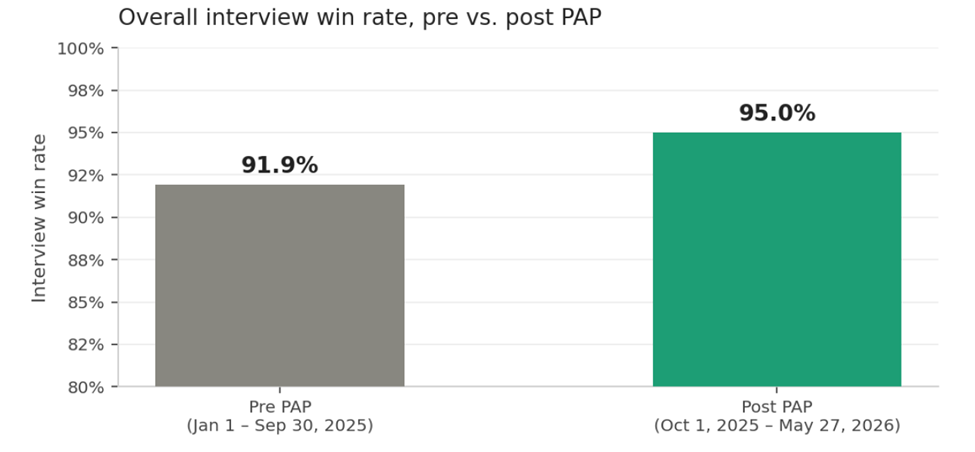
Figure 2: Overall Interview Win Rate [2]
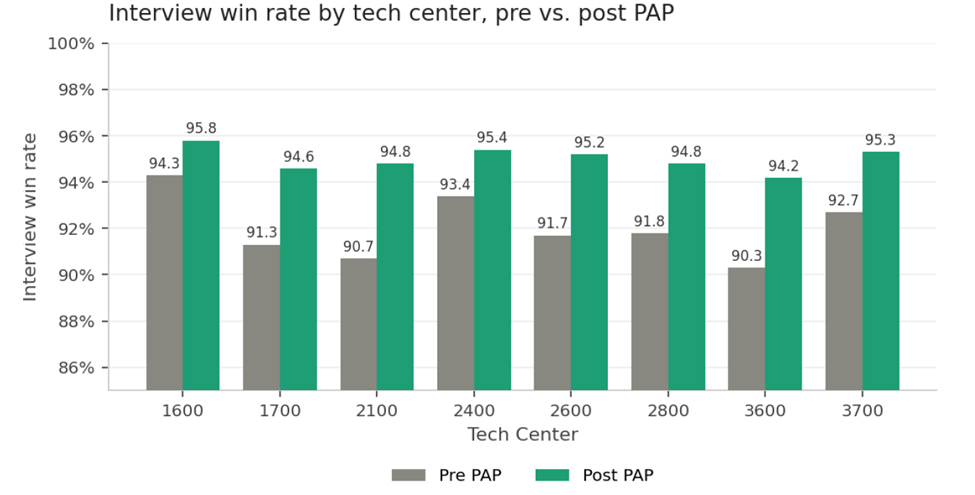
Figure 3: Interview Win Rate by Technology Center [3]
Additionally, the data showed a 5.5 percentage-point improvement in interview win rate for applications in post-RCE prosecution. Specifically, the interview win rate post-RCE improved from 86.5% pre-PAP to 92% post-PAP.
| Cohort | Pre-PAP Win Rate | Post-PAP Win Rate | Change |
| Pre-RCE Prosecution | 94.7% | 96.5% | +1.8% |
| Post-RCE Prosecution | 86.5% | 92.0% | +5.5% |
| Overall | 91.9% | 95.0% | +3.1% |
Figure 4: Interview Win Rates Pre-RCE and Post-RCE [4]
How Does This Affect Prosecution?
Overall, the data indicates that interviews are becoming more effective tools for advancing prosecution, with higher interview win rates increasing the likelihood of receiving a Notice of Allowance. The improvement is particularly pronounced in post-RCE prosecution, where interview win rates show the largest gains. Although the data does not directly identify causal drivers, the pattern is consistent with increased selectivity and more favorable resolution of cases that reach the interview territory.
In contrast to the interview win rate, overall allowance rates have decreased after the FY26 PAP was implemented. The allowance rate measures the share of applications that are allowed, out of all applications that reach a final disposition (allowance or abandonment). Overall, the allowance rate decreased by 3.4 percentage points, from an average of 81.9% pre-PAP to 78.5% post-PAP. There is a caveat though. Applications allowed in October-December 2025 reflect prosecution decisions and interviews conducted months earlier (typically Q2-Q3 2025), so the early post-PAP allowance numbers are still shaped by pre-PAP examiner behavior. The Q1-Q2 2026 numbers (77-80%) are a cleaner read on post-PAP-only behavior, and they sit consistently below the pre-PAP baseline. Also we note that the December 2025 allowance rate sits 8-9 pts below the pre-PAP average. Examiner end-of-fiscal-quarter docket-clearance behavior is part of the pattern, but the magnitude is larger than typical seasonality. December is also two months into the new PAP, so it can indicate a confusion amongst the examiners about the new rules leading to a sudden behavior-shift. A deeper investigation outside of the scope of this client alert is desired to explain the December 2025 dip in allowance.
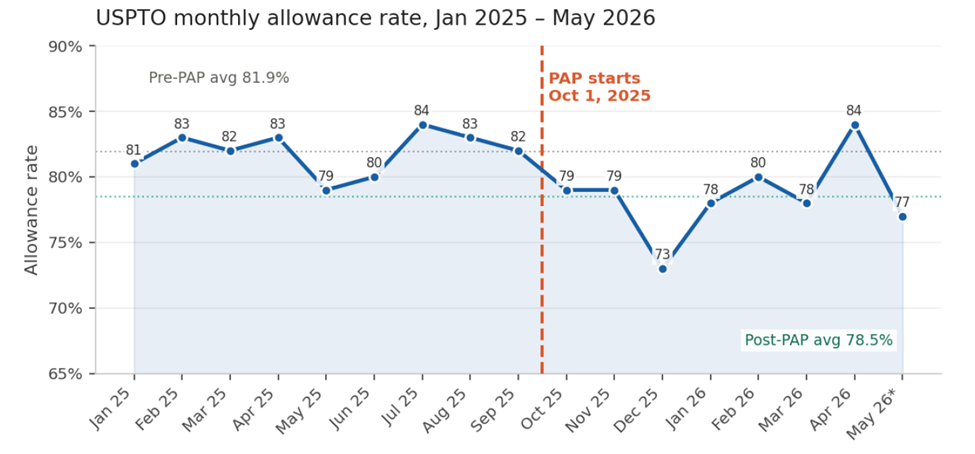
Figure 5: Monthly Allowance Rate [5]
How Does This Affect Prosecution?
The overall decrease in allowance rates may suggest that fewer applications are progressing to allowance before reaching the interview stage. The contrast between declining allowance rates and increasing interview win rates suggests a more selective and outcome-driven prosecution environment under the FY26 PAP. Although fewer applications overall appear to proceed to allowance, those that do reach the interview stage appear more likely to be resolved in favor of the applicant. Thus, interviews may represent a critical inflection point in prosecution strategy, as applications that reach the interview stage appear increasingly likely to achieve favorable outcomes. As interviews become more selective and consequential, applicants may have fewer opportunities during prosecution to refine claim scope, test examiner positions, or use interviews to move a case toward allowance. Accordingly, front-loaded claim drafting and early prosecution strategy may become increasingly important.
The overall timing of interviews within a prosecution cycle has not changed significantly. Most interviews continue to occur after the first non-final (NF) office action, with the percentage of interviews declining after each subsequent office action. Note that the Y-axis is indicated as the count of “Interview Office Actions”. An Office Action is counted as an Interview Office Action if an examiner interview summary was filed. Once again, since the pre-PAP window is longer than the post-PAP window, the raw counts of Interview OAs are different. It appears that post-PAP the interview scheduling after the first OA has become slightly higher (57.3% compared to the pre-PAP 53.7%), possibly indicating that practitioners are aware that Examiners may not grant subsequent interview requests. We expect this number to go up as Examiners are less likely to ask for supervisor examiner approval for subsequent interview requests.
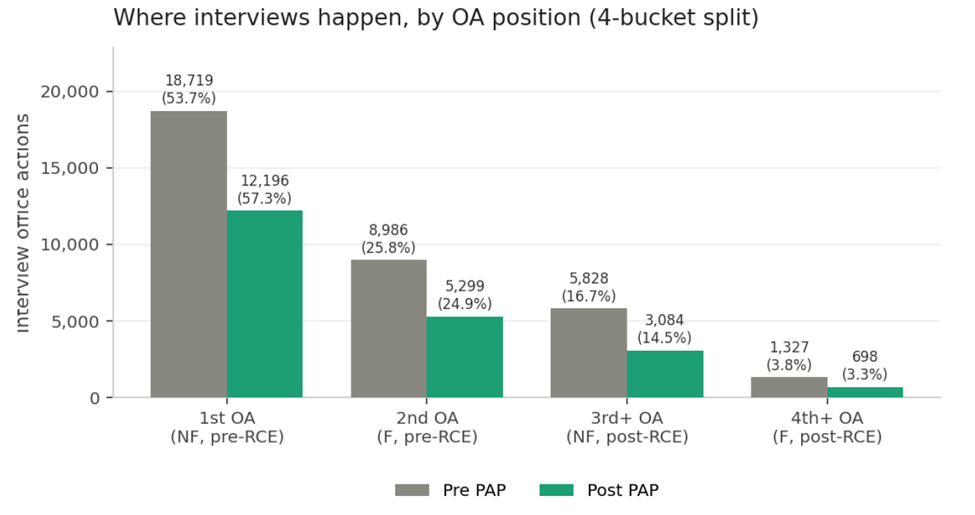
Figure 6: Interview Timing [6]
How Does This Affect Prosecution?
Consistent interview timing indicates that applicants are continuing to request interviews at similar stages of prosecution. However, the increase in interview win rates suggests that interviews are more often associated with favorable outcomes. Taken together, this suggests a shift not in when interviews occur, but rather in the role of interviews in shaping case outcomes.
Overall, the observed trends are consistent with a more selective prosecution environment after implementation of the FY26 PAP. Although overall allowance rates declined during the post-PAP period, interview win rates increased, particularly in post-RCE prosecution. Such trends suggest that interviews may now play a more significant strategic role in cases that are deemed to be worth interviewing, even as fewer applications overall proceed to allowance. If favorable outcomes are increasingly concentrated among applications that reach the interview territory, applicants may benefit from investing greater effort in front-loaded prosecution strategy (e.g., initial claim drafting, specification support, and early response strategy) to maximize the likelihood of reaching a productive interview stage. Given that this analysis is based on early post-implementation data, the observed trends should be treated as preliminary and subject to further development over time.
[1] U.S. Patent & Trademark Office, USPTO Hour: Understanding a Patent Examiner’s Role in the IP Community (FY26 Examiner PAP Changes presentation slides, 2025), slide 25.
[2] Juristat USPTO Analytics, custom report prepared for Buchalter (May 2026).
[3] Juristat USPTO Analytics, custom report prepared for Buchalter (May 2026). Tech Center 2900 for Design is excluded.
[4] Juristat USPTO Analytics, custom report prepared for Buchalter (May 2026).
[5] Juristat USPTO Analytics, custom report prepared for Buchalter (May 2026).
[6] Juristat USPTO Analytics, custom report prepared for Buchalter (May 2026).
This communication is not intended to create or constitute, nor does it create or constitute, an attorney-client or any other legal relationship. No statement in this communication constitutes legal advice nor should any communication herein be construed, relied upon, or interpreted as legal advice. This communication is for general information purposes only regarding recent legal developments of interest, and is not a substitute for legal counsel on any subject matter. No reader should act or refrain from acting on the basis of any information included herein without seeking appropriate legal advice on the particular facts and circumstances affecting that reader. For more information, visit www.buchalter.com.